everything feels lighter and somehow possible
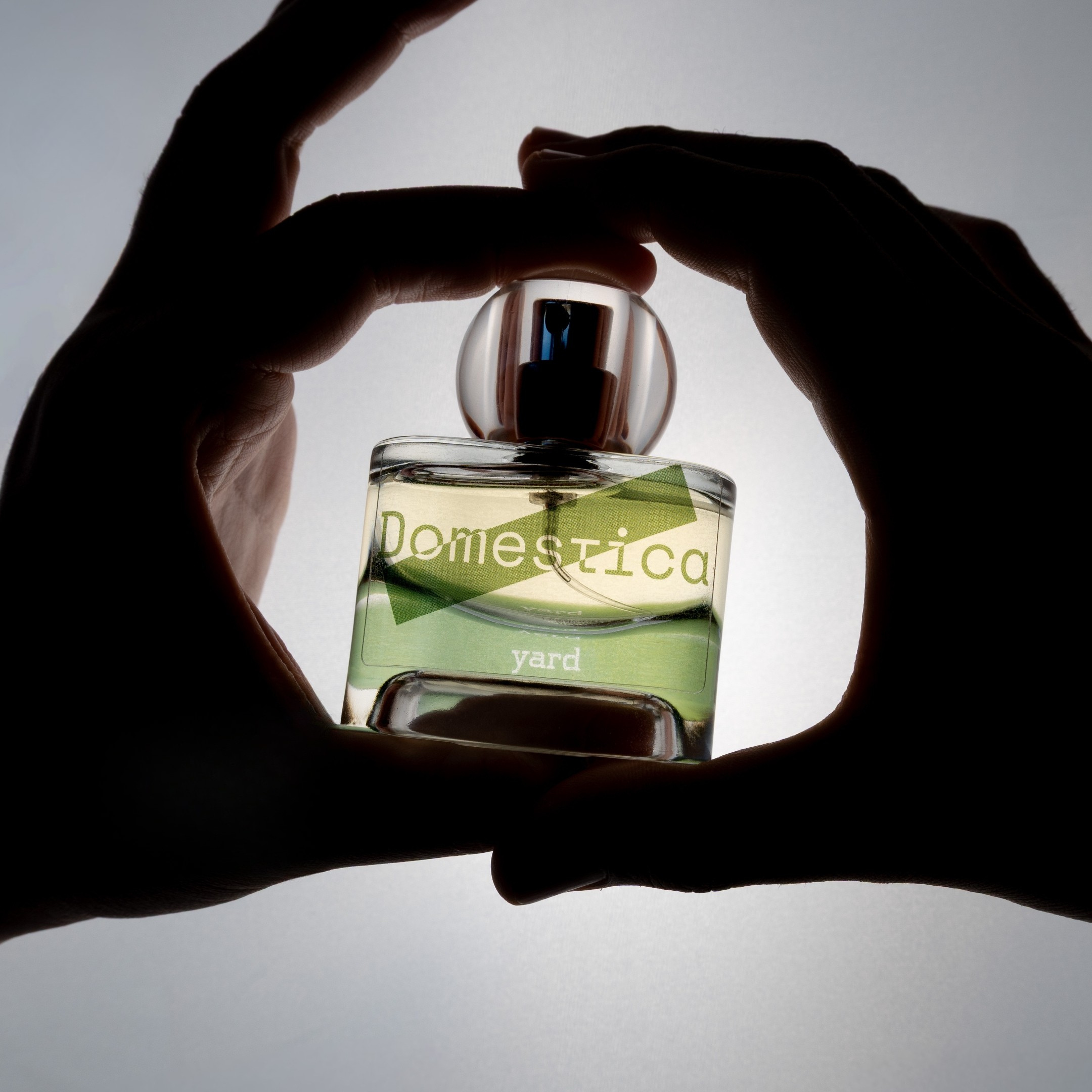
Some perfumes want to take you somewhere else.
Domestica stays close to a memory, to the body, to the kind of moments you barely notice until they're gone.
What does your apartment smell like right now?
It smells like isocyclocitral, which smells like a flower shop and hay absolute, which smells like—you guessed it—hay. The former is what gives Yard the wet, dewy petal quality. I didn’t think that isocyclocitral is a particularly tenacious aromachemical, but after all the compounding we did ahead of Fumed Expo in Chicago, it’s the main smell wafting from our trash bins, even after they’ve been emptied. The hay absolute is a key component of a new perfume coming this summer.
What's the earliest scent memory you can remember? Do you think it still shapes what you make?
Alvaro: As a child of Mexican immigrants, I grew up between two worlds. While I spent most of the time living here in the States, I spent most summers as a child in Mexico on our family farm, taking almost 3 months between school years on the ranch, and there is a smell that I can never forget.
The smell of the wet dew in the morning, a light smell of diesel from the trucks and tractor, a stillness that you can smell. I colloquially call this the smell of Latin America, and every once in a while on a crisp day in Chicago after a bus passes, I get a hint of the smell and I am transported back.
Marty: I’m not sure if it’s the earliest scent memory, but some of the strongest scent memories that come to mind from my childhood come from cooking, particularly breakfast. My parents have always been early risers and I recall getting out of bed to the smell of many breakfasts that were already underway: toast, butter, eggs, oatmeal, pancakes, Pop-Tarts.
Breakfast is still my favorite meal of the day. While I have yet to drop a breakfast perfume (stay tuned), I do think that these kinds of smells shape what I gravitate towards in perfumery. I like to create scents that feel lived-in and habitual, almost like you can smell the human being in the scene that the perfume is setting.

Have you ever made something that felt too private to release?
Not yet, but I have a draft or two that feel either not quite right for Domestica or like something that I want to keep for us. It’s less about the perfume feeling like too much to reveal and more about whether it fits into the world of our brand. I’m also really into the idea of creating custom perfume for our wedding celebration (we’re already married but have yet to throw the party).
How do you decide what to keep from a memory and what to leave out?
We want all of our perfumes to be snapshots of a memory, but intentionally leaving out some context. While I’ve grown accustomed to perfume notes that include explicit materials (bergamot, tonka, benzoin, etc.), we think it’s fun to include just a few easily digestible composite notes as well: wet vegetable garden, band-aids, fruity cereal. In this way, we can set the scene without being explicit about how you arrive there.
For example, one of our favorite things about Yard is hearing how each person arrives at that damp backyard scene: it’s a hot summer day and you’re drinking from the garden hose; your grandma used to smell like the elusive cucumber/bell pepper/melon notes when she came back from tending to her vegetables; you loved rolling down a hill in your neighborhood with your friends.
We like using a few key notes/accords as entry points, and the unspoken parts help render the scene for someone. It’s a delicate balance, but we find that there’s a point where the perfume reaches just the right amount of specificity without being entirely autobiographical.
When you disagree on the direction of a scent, how do you resolve it?
We tend to know at first sniff if a formulation is Domestica-worthy or not. When we first got the inkling that we should collaborate on something creatively, we didn’t set out to launch a perfume brand. All we knew was that we needed to do something creative and make something entirely our own.
We settled on a mantra to guide our work: everything feels lighter and somehow possible. If the creative process, like the development of a scent or the translation of the visuals, starts to feel “heavy and I need to do it perfectly all on my own,” we return to that mantra. To us, Domestica is made up of confabulated memories of the childhood that we wished we shared together.
It’s a celebration of the mundane. If something doesn't give us that feeling, or wanders too far into fantasy territory, it's not Domestica. We won’t be precious about the initial idea, we’ll simply head back towards the Domestica feeling.
Does Alvaro ever smell something and think: this isn't what I imagined visually?
Hundy p (100%). I actually feel like it happens most of the time when I smell the progress of what Marty is making. We workshop ideas for perfumes together a lot, so as the vision gets stronger we kinda pull each other in the right direction. It's kinda like a corset, each lace you pull shifts the tension from one side to the other until you hone in on the grounding detail that makes it feel like the visuals represent the world where the perfumes live. I literally think about the perfumes as characters and think, would they live here?
What changes when a memory becomes something physical through scent?
With Domestica, we want to give enough context through the scent, the visuals, and the narrative to anchor it in a setting, but not so much that it defines the experience. What changes when memory becomes something physical through scent is this: playing with and respecting the fact that our memories are erroneous, that mistakes in memory happen and are part of our lived reality. A perfume does not transport you to a perfectly-formed memory, but it helps us translate our own personal experiences, however imperfectly.
“Domestica lives at the tension between memory and imagination, to play with the fuzzy edges of them and combine what we think we remember and what we want to remember.”
Do you think about how your fragrances interact with a space, a room, a memory of a place? Or is it always ultimately about the body wearing it?
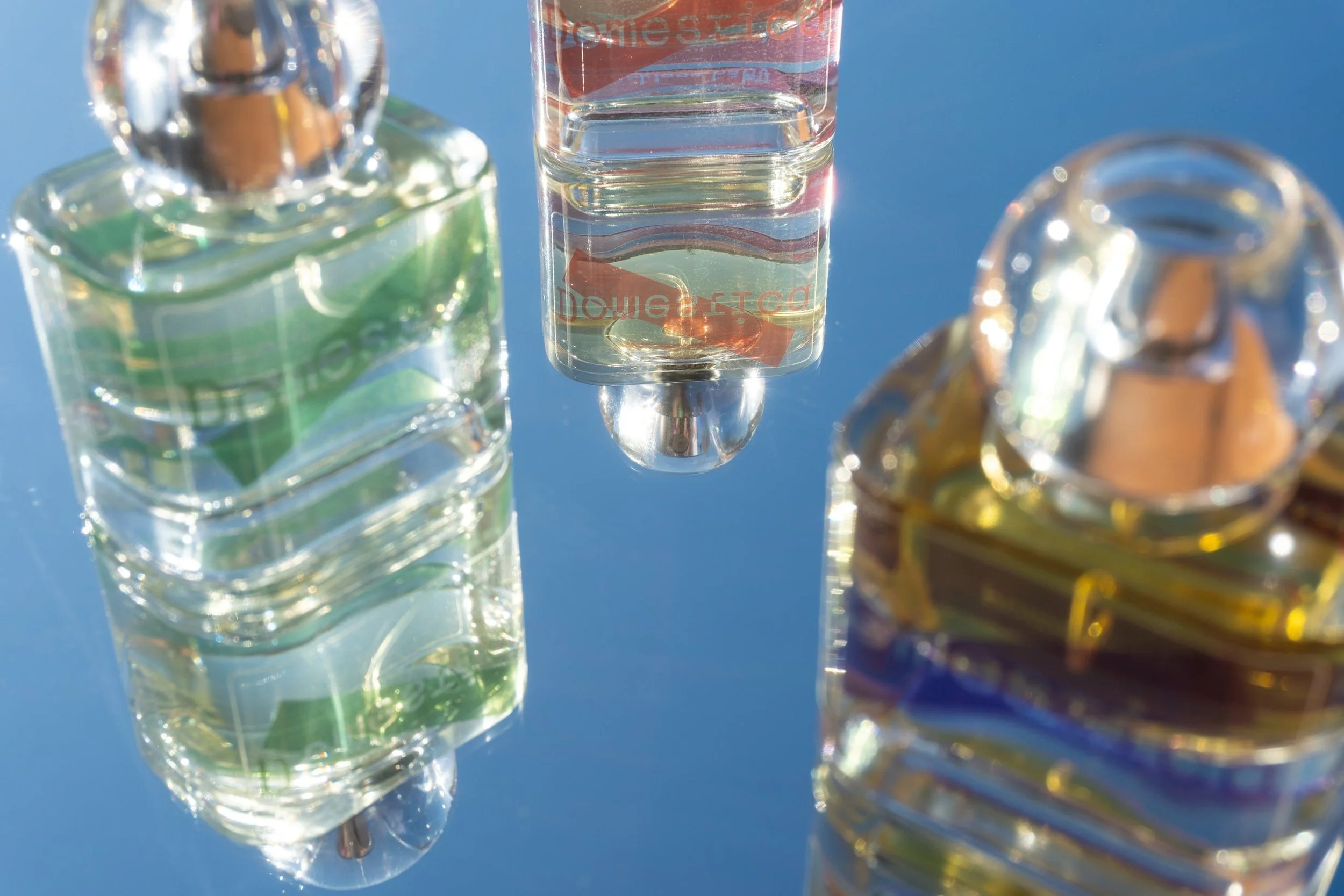
Our fragrances are very much about the body wearing them, especially Home with You, which is designed to be a sort of companion for sick days. There’s a sweet, warm sweatiness to it in the dry down that’s very bodily on its own, and becomes even more so when it's worn on skin. I will say that when I’m making large batches of Yard and Reckless Baby, they both have a nice throw to them that always cheers me up.
They almost make the space they’re in vibrate, I think because they have materials with a sort of sparkly edge to them. In that sense, it’s nice to think about how they can fill a room. But ultimately, perfume is so much more interesting when someone wears it. Just like the perfect vintage leather jacket, everyone’s body fills it out differently.
What makes something ordinary suddenly feel intimate when translated into scent?
This is perhaps the core question that guides our work. Many perfumes are about dramatic escape to other worlds, other selves. We want people to be curious about themselves, about the banal happenings of everyday life, and to escape laterally, into the arms of people around them.
As we said earlier, there’s something special about giving someone one detail of a scene—drinking from a hose, opening a pencil box, spending a sick day in bed—and letting them do the rest of the scent-memory connecting. The intimacy exists in the privilege of someone trusting us to surprise them, to let us take them somewhere when we don’t know where they could end up.
It’s one thing to list notes and write copy that shapes someone’s experience of a perfume; it’s another when that person actually experiences it. Like Miss Frizzle’s Magic School Bus, we want our perfumes to whisk you away in unexpected and playful ways.
Your work sits somewhere between personal and shared experience. When does something private become something others can feel?
We think privacy is the point when it comes to perfume. You won’t feel much of anything from a perfume if it doesn’t reflect something private. We often find parallels between scent and music, and this is one key way that they’re alike: the music we enjoy relies on conveying intimate experiences for public consumption and our perfumes are no different.
Of course, everyone has their own interpretation of the end result, but ultimately the point is to see ourselves reflected somewhere in it. It’s an exercise in empathy for the audience and for the artists. It is scary and vulnerable to put yourself out there, but the best art is vulnerable, raw, and unfiltered.
Do you think scent can carry cultural or social narratives, not just personal ones?
The personal is political, and that includes perfume. The perfume we make and the perfume we wear says a lot about us. Of course, we bring a queer perspective into our perfumes and the world of Domestica, and Domestica reflects it back at us and at those who enjoy our perfumes. Much of the perfume world is still interested in a sort of Eurocentric lineage, particularly when it comes to education in perfumery.
Even some smaller details like bottle manufacturing and material sourcing are rooted in Eurocentric perspectives. Perfumery resources are still heavily concentrated in the hands of huge conglomerates. Right now though, I think we are in a really fascinating spot in the perfume world—especially when it comes to indie fragrance—where so many previously unheard voices are speaking up. So many of our fellow indie perfumers have beautiful cultural and personal stories to tell, and the increasing accessibility of perfume education and materials has made it possible for more self-taught perfumers to share their art with the world.
The ability to connect with people across screens has also allowed us to share Domestica with an audience we wouldn’t have otherwise reached.
How does queerness shape the way you think about scent? Is there a smell you associate with queer spaces or experience that mainstream perfumery never bothered to capture?
We’re a married queer couple, so our perfumes are inevitably queer in that way. The queer perspective is so often reduced to sexual attraction but there is so much more to the experience—particularly when you’re a child—that goes into building your world view. It’s interesting to see that same reductive narrative run through perfumery as well.
And we love many of the perfumes that proudly translate that depravity and sexual liberation! Our perfumes are not about that. There is also a very gentle, nuanced side of queerness that we want to capture in our perfumes. To be queer is to question and wonder,and we intentionally put some distance between the scent notes and the finished product so there’s ample room to be surprised. For many non-queer people, social norms and expectations are upheld and never questioned. Queer people don’t have that luxury, and we hope to bring that same kind of quiet upheaval to our perfumes.
Mainstream perfumery cannot capture the tension between fear and liberation that comes with questioning your essence and knowing that leaving behind familiar structures is better than staying within them.
Scent might be the last sense AI can't fully replicate. Does that feel like a refuge to you, or does it add pressure?
In its current state, AI cannot replicate human senses. It’s misguided to think that AI can supplant human creativity. AI models are simply a mirror, and humans find what they want in its responses. All the current AI models are driven by efficiency, productivity, ease, time-saving—all of which are antithetical to the creative process.
Taking all of that into account, does scent feel like a refuge or a source of pressure? I think the answer is neither. Scent is ephemeral and temporal. It’s a glimmering passage to walk down for a moment, one that reminds us that the passing of time is what the human experience is all about. We’ve made a few parallels to music here before, but scent is another route where people can find sanctuary in shared intimate experiences in a way that the physical realm cannot.
Confabulation, the brain filling in gaps with invented memories, feels strangely close to how AI generates content. Does that parallel ever come up for you?
We find that parallel very funny. Like any human creation, AI’s flaws are a reflection of our own flaws. Of course AI’s attempt to recreate or generate responses mirrors our own. When AI fails to make solid connections between ideas, it fills in the blanks as best as it can. So do our brains.
We don’t use AI in any part of our creative or business processes (we’re staunchly against it), but we can definitely see the dark humor in its representation of the human condition.
“We hope that the AI bubble will pop so humans can stop pouring unimaginable amounts of money and resources into something so empty.”
Nothing feels forced or finished. Just fragments that stay with you longer than they should. And instead of a picture, you leave with a feeling.
